
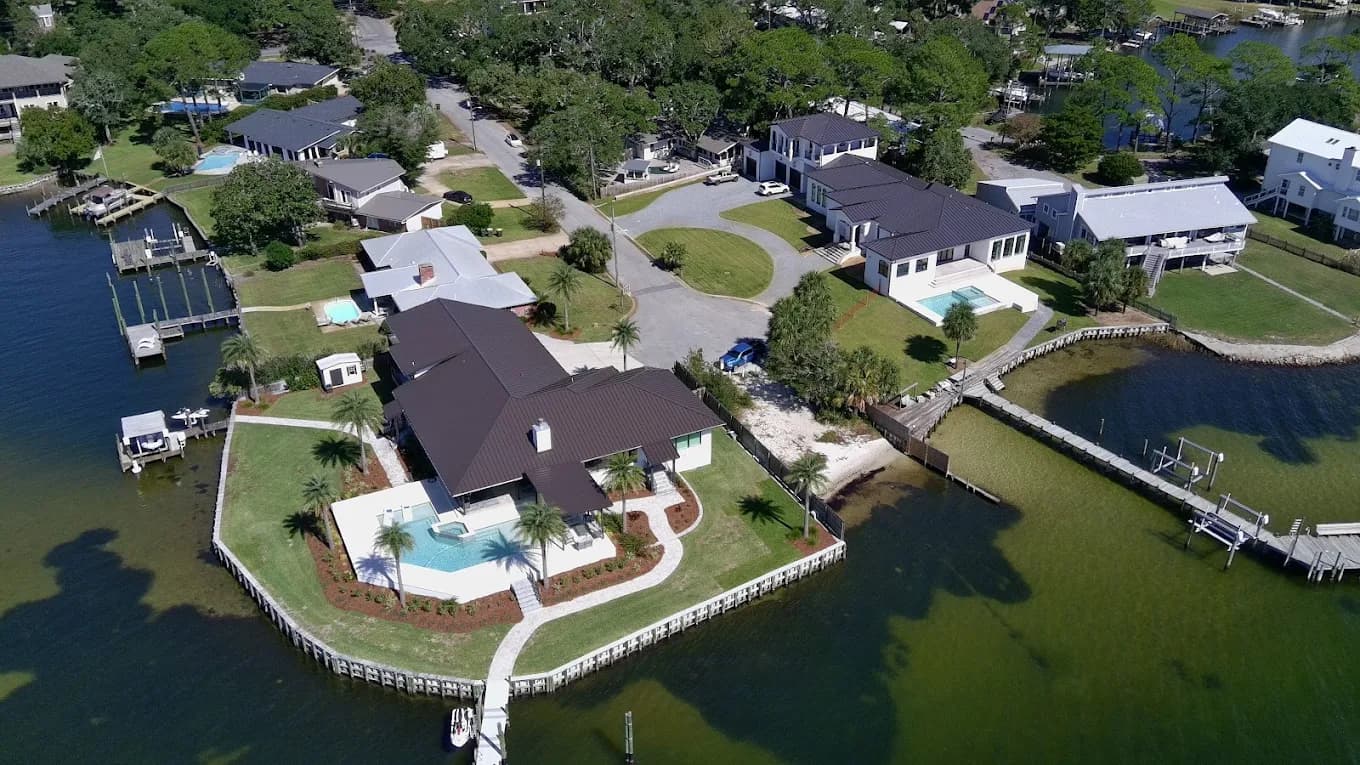
If you live within sight of the water, your roof is fighting something the inland roofs aren't. Salt air is corrosive, it's constant, and it doesn't take a hurricane to do damage. Every breeze off the Gulf carries a fine salt mist that settles on your shingles, works into your fasteners, and sits on every piece of exposed metal up there. Over years, it adds up. We see it on roofs from Pensacola to Panama City, and we've learned to build for it.
The good news: a coastal roof and an inland roof aren't built the same way, and the upgrades that hold up against salt air are small money on the front end. Here's what the salt actually does, how close to the water it matters, and what we spec on coastal homes to buy back the years.
What salt air does up there
Three things, mostly. First, fasteners corrode faster. The nails and screws holding your roof down are metal, and salt accelerates rust. A corroded fastener loses its grip, and a shingle with a failing nail is the one that lifts in the next strong blow. Second, granule loss speeds up. The granules on an asphalt shingle are its sunscreen, and salt combined with our sun and humidity strips them faster here than almost anywhere. Bald spots mean the asphalt underneath is cooking. Third, exposed metal pits. Your flashing, your drip edge, the metal around chimneys and vents: salt eats at it, and pitted flashing is where the leaks start.
Add it up and a coastal roof simply has a shorter service life than the same roof three miles inland. That's not a defect, it's the environment. A roof that should give you 22 years can give you 17 on the beach if it's built like an inland roof. Built right for the coast, you get most of those years back.
How close to the water it matters
Roughly within a mile of the Gulf is where we treat a roof as coastal, and that covers a lot of homes: Pensacola Beach, Navarre, Destin, and Panama City Beach all sit in the salt zone. But it isn't only the Gulf side. The bay and sound sides carry salt too. Homes along Santa Rosa Sound, around Choctawhatchee Bay, and out on the Pensacola side of the bay see the same corrosion, sometimes worse where the air sits still and the salt doesn't blow off.
If you're not sure whether your home is in the zone, the simplest tell is your neighbors' roofs and your own hardware. Rust streaks on metal, premature granule loss in the gutters, lifting tabs on a roof that isn't that old: that's salt at work. A roof inspection will tell you where you actually stand.
What we spec for coastal homes
We change the parts that salt attacks. For fasteners, we use stainless steel or hot-dipped galvanized instead of standard coated nails, because those are the ones that hold their grip for the long haul. For the exposed metal, we use upgraded and coated flashing and drip edge that resist pitting instead of bare or thin galvanized stock. Underneath, we run a coastal-grade underlayment and seal the deck, so even if the surface takes a beating the water has nowhere to go.
For the surface itself, we lean toward a higher-grade architectural shingle, usually a Atlas system since we're an Atlas Pro Plus Diamond contractor, and where it fits the house and budget, metal is a strong coastal option for its corrosion resistance and lifespan. We walk through that choice in shingle vs. metal. And we finish with good ridge ventilation, because heat and moisture trapped under a coastal roof age it from the inside out. Every layer of this meets or beats the Florida Building Code for our wind zone.
The cost, honestly
The coastal upgrades add a little to the upfront price. Stainless fasteners cost more than standard nails, coated flashing costs more than bare, and a coastal underlayment runs higher than the baseline. On a typical home it's a modest line item, not a different roof. What you get for it is years of extra service life and far fewer of the small failures that turn into leaks: a lifted tab here, a rusted nail there, a pitted piece of flashing that finally lets go in a storm.
We tell every coastal customer the same thing: don't pay to build an inland roof on the water and then replace it early. Spend the small premium once, get the years. If a reflective surface is also on your list, an ENERGY STAR rated shingle can cut attic heat in our climate.
Where to start
If you're on or near the water anywhere from Pensacola to Panama City and your roof is getting up in years, the move is to have someone who builds for the coast walk it before the next storm season. We'll tell you straight how the salt has treated it and what it'd take to do it right. Free estimates anywhere in our service area, no pressure.
Two related reads: if you're weighing whether it's time, repair vs. replacement lays out the decision, and shingle vs. metal covers the material call once you've decided to replace.