
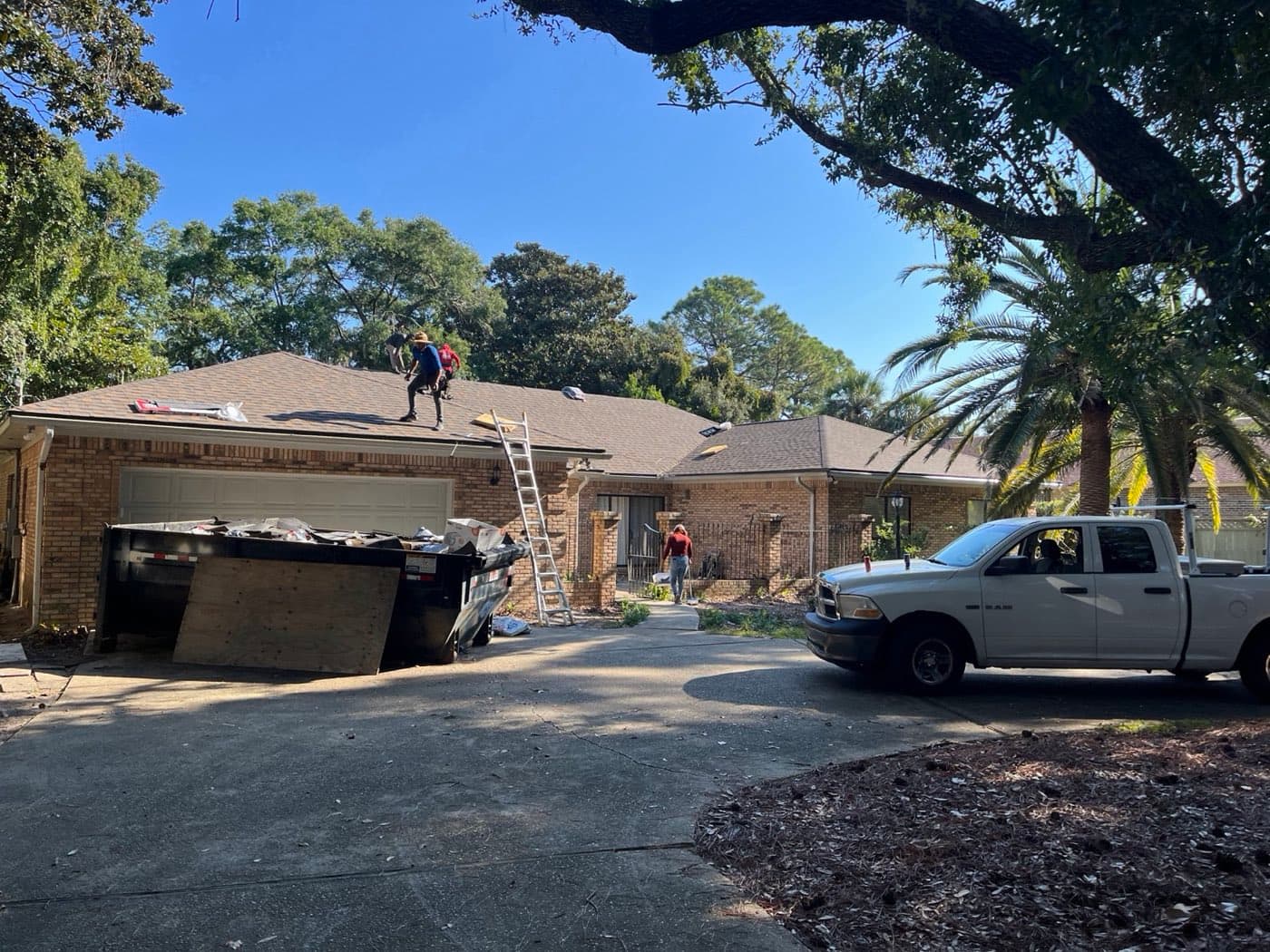
Every week we get the same call. Somebody saw a leak after a storm, or a neighbor's roof just got replaced, or an inspector flagged something on a real estate listing, and now they want to know: do I need a roof repair or a full roof replacement? The honest answer depends on four things: how old the roof is, how widespread the damage is, what your insurance situation looks like, and whether your roof would meet current Florida code if we opened it up.
Here's the framework we walk customers through on the phone before we ever schedule a quote. It won't replace an on-roof inspection (most roofs have at least one surprise once you pull a shingle), but it'll get you 80 percent of the way to the right answer, free.
Start with the age
Architectural shingle in Northwest Florida realistically lasts 18-25 years. Three-tab shingle, which is what most homes built before 2005 originally had, lasts 12-18 years here. Coastal homes (anything within a mile of the Gulf, so Pensacola Beach, Navarre Beach, Destin, Panama City Beach) shave 3-5 years off both numbers because of salt air. We cover the salt-air piece in detail in Salt air and shingles.
If your roof is under 10 years old and the damage is localized, you're almost certainly in repair territory. If it's over 20 years old and you have any damage at all, you're almost certainly in replacement territory. The middle band, 10-20 years, is where the other three factors do the deciding.
Look at the scope of the damage
A single missing shingle? Repair. Three or four damaged tabs on one section? Repair. A whole slope where the laminations are lifting and the granules are washing? Replacement territory. A leak that's affected the decking underneath? Almost always replacement, because once the decking goes wet you're not just patching shingle anymore.
Florida has a specific rule that matters here: the 25% rule. If more than 25% of the roof is damaged and the existing roof doesn't meet current Florida Building Code, the carrier and the local building department can require a full replacement. That's the line where a big repair becomes a code-required reroof. If you're filing a storm damage claim, this rule shows up constantly.
Run the insurance math
If a storm caused the damage, the math changes. A claim covers either a repair or a replacement depending on scope, and your out-of-pocket is usually just the deductible. Repair claims are faster but can come back to bite you. If 30 percent of your roof was damaged and the carrier only paid for a 30 percent repair, the other 70 percent is still aging, and you'll be filing again in 3-5 years.
On uninsured damage (old roof, no storm), the math is different. A repair on a 15-year-old roof might buy you 2-3 years; a replacement gets you 20+. Sometimes the repair is right because you're selling in a year and don't want to put a roof on for the next owner. Sometimes the replacement is right because you're staying and the math over 20 years favors a new system. We walk through both options on every quote.
Code is the wildcard
If your roof was installed before 2007, it almost certainly doesn't meet current Florida Building Code. That matters because once we open it up for a significant repair, the building department can require code upgrades: drip edge, ice and water shield, current fastening schedule, current ventilation requirements. Those upgrades add cost, and they're sometimes required on what started as a repair.
On an insurance claim, code upgrades are usually covered (ordinance and law coverage is part of most Florida homeowners policies). On an out-of-pocket repair, code upgrades come out of your wallet, and at that point a full replacement that brings the whole roof to current code sometimes makes more financial sense than a repair that triggers partial upgrades.
The quick decision tree
Pull this out the next time you're wondering: Under 10 years and localized damage → repair. Over 20 years and any damage → replacement. In between: if it's a storm claim, file and see what the carrier scopes; if it's out of pocket, get a quote for both options and look at the 5-10 year math. Either way, the right next step is having someone walk the roof. We offer free estimates anywhere in our service area, and we'll tell you straight which one you actually need.
Two related reads if you're working through this: What hurricane season does to a panhandle roof covers the storm-damage angle, and Shingle vs. metal covers the material decision if you decide to replace.